Return to Denali: Up the Cassin Ridge to the Summit

After 6 days on the wall we stand on the summit. At last! It is 24 June, a little past 7 pm. The sun is still high on the horizon. Exhausted but happy. We do not have to go any higher! For a moment at least the feeling of tension falls away and the long-desired feeling of satisfaction and relief arrives. We have not eaten for two days. In my jacket I hide the last bar as a little rescue from hunger. But the descent still awaits us!
Denali is one of the Seven Summits, the highest peaks of the individual continents of our planet. It is not that high (6,194 metres), but in terms of rise from the base of the mountain it surpasses even Everest itself. At the same time, the conditions that prevail here are among the harshest in the world. Extreme frosts, wind, snow. That makes Denali a real tough nut. The mountain is normally climbed by the so-called normal route, the West Buttress. Our goal, however, was the south face, and specifically the Cassin Ridge line, which is among the hardest. Every year around 1,000 people attempt Denali, and this year was no different. But on the face itself, on average 1% of all of them try. For interest, this year 35% of all those who attempted Denali were successful.

Denali and its harsh face… That was last year.
We had already tried Denali last year. Unsuccessfully. In May, when the weather was supposed to be at its most stable, the worst conditions I have ever experienced prevailed. Extremely low temperatures, strong wind and snowfall. Only 3 days of good weather in the entire time. It was impossible to get onto the wall, never mind climb it. All we had left was a view, often of a wall of clouds from behind which the south face occasionally emerged. And so Denali clearly showed us how inhospitable an environment it can be here.
We will be back…
I would not have expected it to be this year. After last year I told myself that we would take a break from this mountain. The chance of success is not great, but the cold certainly is. But fate wanted otherwise, and so at the beginning of June we pack our things and set off for Alaska again. Hopefully a little wiser than last year. This time we decided to push the expedition to the second half of June. We believed this might be the right move. We are definitely taking more warm gear and food with us. It was clear that I would have to change my climbing gear too. Specifically the ropes. It was time to choose, and I could not reach for anything other than Tendon ropes. I was interested in weight, packability and, linked with that, both the diameter of the ropes and their durability. Here I was clear: Tendon Master PRO 7.6 ropes, that is, half ropes in bright green and orange.
From the very moment of landing in Alaska everything went very quickly. The weather was on our side, so there was no reason to linger down below. Not even 24 hours had passed from arriving in Anchorage and driving to Talkeetna, and we were sitting in a small plane headed for the Kahiltna glacier. Goodbye civilisation and comfort. Welcome adventure.
In the icy grip
There is nothing on the glacier. Just others who thirst for the summit. And our things. What we have not taken, we will not have. You have to be prepared and forget nothing. Denali is not high, but it overwhelms you with its mass. Especially the south face, more than 2.5 kilometres high. The course of the expeditions is the same as on other mountains, from acclimatisation to the summit attempt itself. The trail was beaten down, since most people had already been here. On the glacier the ropes therefore rest peacefully in the backpacks, all the way up to C4 at 4,300 metres, where we made our base camp this year. We knew that we would want to descend beneath the south face via the West Rib. For us this meant one day of preparation, during which we also checked the weather. We have to go! While the window is open. The plan is two days of approach, 4 days on the wall and then descent by the normal route back.
Luck was on our side
I would describe the approach beneath the wall itself as scary. Something I never need to repeat in my life. We climbed the West Rib free, without ropes, then came a twist and we had to go steeply down the so-called Seattle Ramp to beneath the south face, into the Valley of Death. One rope in the backpack, the other connecting us like an umbilical cord. We do a large part of the descent backwards. We do not avoid falls into crevasses, nor from a serac. In the end, in the Valley of Death a massive avalanche only narrowly misses us when an ice block breaks off somewhere a kilometre above us and flies through the wall. Only its edge and the pressure wave hit us. We were lucky! The aftermath was a body shaking with stress. Away quickly! Now I know why it puts so many people off.
We are on the wall. At last!
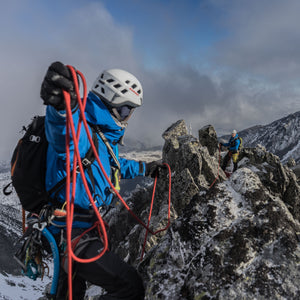
Mixed, vertical ice, deep snow, pure rock, a razor-sharp ridge. We experience perhaps everything. From fairly comfortable bivouacs to those where we squeeze onto narrow ledges that we had to chop out of extremely hard ice. In the end even a storm slows us, trapping us at roughly 5,200 metres. The Japanese Couloir is something like an alpine north face. A long narrow gully that ends in the ridge. I did not even count the pitches, but we spent the whole day in it. The hardest rock section followed: a chimney that ended in the dreaded Cowboy Arête. An ice ridge sharp as a razor. Hard blue ice with snow on top that does not hold. We protect some sections, elsewhere the protection is just for the feeling. Behind it, however, is a nice place for a bivouac, and above it the overhanging glacier and the first rock barrier (Rock Band). The green rope between us, the orange one hidden in the pack for emergencies. We started climbing with one, and so we continue. Above the first rock barrier is a second one. Both combine mixed climbing through the various gullies, slabs and blocks that thread them. Then "just the final climb" to the summit. It was precisely in this final climb, when 1,200 metres of climbing still lay ahead of us, that a storm caught us. An emergency bivouac in which we squeeze together like sardines in a tin. Frozen into a cube of ice as snow constantly buries us from all sides, even though we are hiding under a rock overhang. I am happy about the new ropes. Mine would already be as hard as concrete. You can see that these conditions are made for them. Only we suffer. The next day the weather allows us only 300 metres of elevation gain on steep slopes, where deep unstable snow alternates with firn and ice slabs. The rope is only a placebo. Hopefully we will finally reach the summit the next day. We are without food.
The final climb itself again proved to be a steep rock barrier, which we climb through snow gullies all the way to Kahiltna Horn. From there it is a stone's throw to the summit. A moment of frozen joy when the wind died down. For the descent we pack the green rope into the backpack too. We have had enough, but we have to get down. The weather plays with us like a cat with a mouse. A supercell that had formed in the meantime hit us with full force. Extremely strong wind, snowfall, zero visibility. The rope covers our backs on the traverse above C5 when we protect ourselves over the anchors. After midnight we are finally there. Still to dig a hole, pitch the tent and crawl inside. Tomorrow hopefully we will finally eat properly. And so it was. Only it was late in the evening. I already knew the descent from last year, but fresh snow turned it into hell. Small avalanches fly around, zero visibility. I see the tent only after the terrain levels out. Until then I only thought I was going in the right direction. But at last we made it! In the following days snow buried Denali. What should have been an easy way down turned into a fight, which we nonetheless successfully completed. What else but a proper burger down in Talkeetna.
In total 3 weeks, of which 6 days on the wall. From the start beneath the wall to the return to C4, 9 days in all. It was demanding, intense, but beautiful! And I thank Tendon very much for equipping us with ropes that we could rely on even in the harshest conditions. Not only were they our umbilical cord, they also held us on the wall when we were huddled in the tent. We managed to climb Denali via the south face and the Cassin Ridge, 30 years after probably the only and last Czech track, that of climber Martin Minařík.
Thank you!
Author of text and photos: Lukáš Jasenský
Mentioned in the story

More stories

Todra: where the history of Moroccan climbing began
The first country on our honeymoon trip through Africa was Morocco. And our first climbing stop was the Tod...
Číst příběh →
Tendon Young Mountaineers 2026: record-breaking final at Čížkovy kameny
On Saturday 19 September 2026 the final of the ninth Tendon Young Mountaineers competition took place at Čí...
Číst příběh →
Boreal multi-pitch, or a slightly different day in Iceland
Vestrahorn: a glacier, a black sand beach, mountains, the ocean and a Viking village in one view. The Stok...
Číst příběh →